Logging a CCP Is Not the Same as Controlling It
Food Safety Series · Part 2
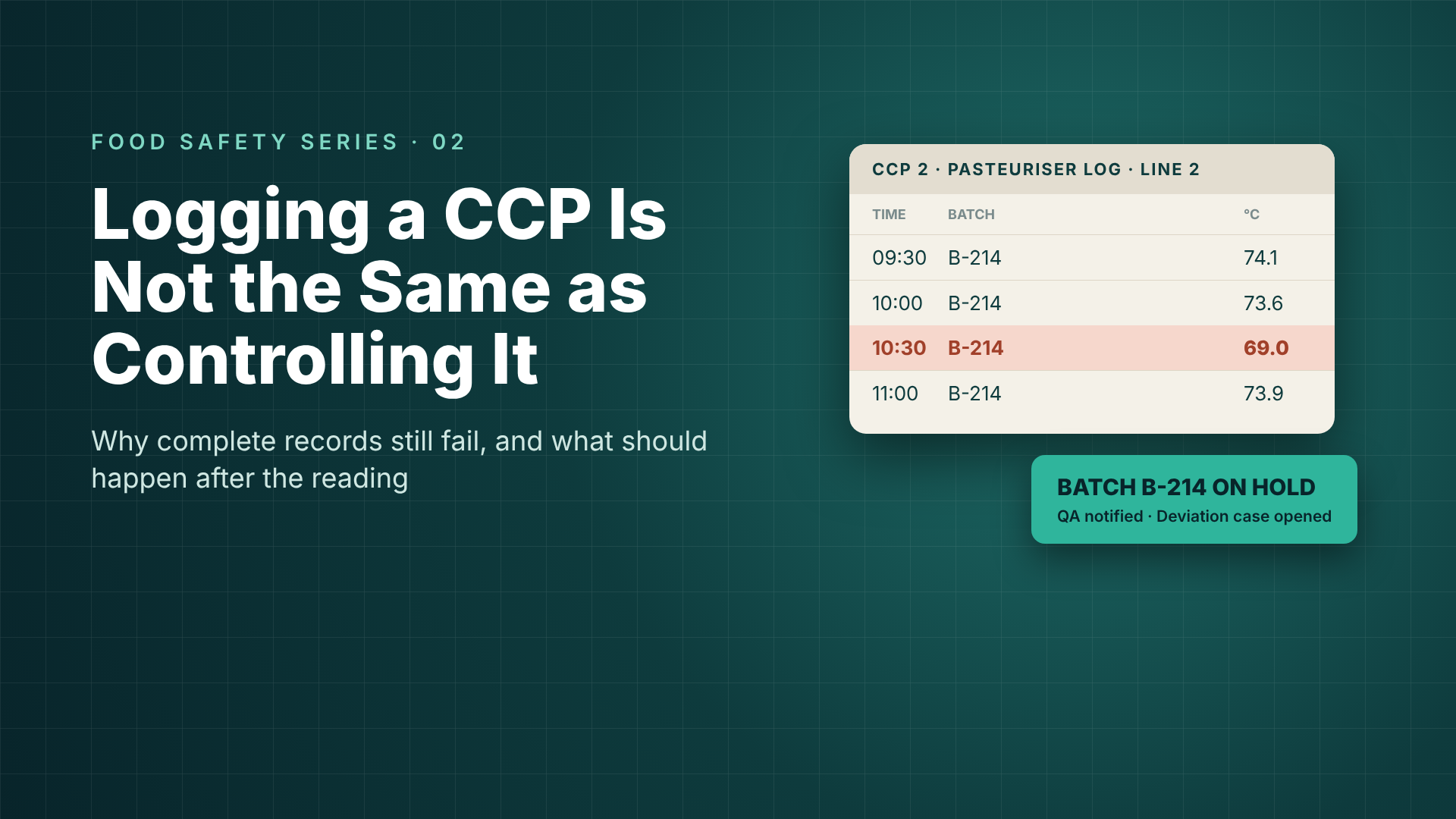
"Our CCP records are complete," the quality manager says. "Every check is logged in Excel, right at the line."
Then the auditor scrolls down and stops. "On 14 March at 10:30 the pasteuriser read 69°C. Your limit is 72°C. Which product was made in that time, what happened to it, and why did it happen?"
The reading was recorded correctly, at the right time, by the right person. But nobody can answer the question.
In the first article of this series we wrote that keeping records is where most plants struggle. This article is about monitoring, and a less obvious problem: in many plants the reading is recorded honestly, on paper or in Excel, but nothing happens with it afterwards.
Recording is the easy part
Let's be fair to Excel. Writing down a temperature takes the same effort in a spreadsheet as in any system. An operator still has to read the instrument and enter the value, and a well-designed sheet can have a column for the batch number too.
So the question isn't where the value is typed. It's what happens in the next five minutes, the next week, and the next time the same problem appears.
What good CCP monitoring looks like
Before any software, four basics need to be in place:
- A clear limit, and the reason behind it. An operator who knows the limit exists to destroy pathogens treats a 71°C reading very differently from one who just sees a number in a box.
- A check frequency that fits the process. Hourly checks on a continuous line can leave close to an hour of product unprotected. Continuous recording, where the equipment allows it, closes that gap.
- A calibrated instrument. A reading is only as reliable as the thermometer or probe that produced it.
- A named person and a defined reaction. Who checks, and exactly what they do the moment a value is out of limit.
Where spreadsheets stop
Here is what typically happens next in a plant that runs CCP monitoring in spreadsheets:
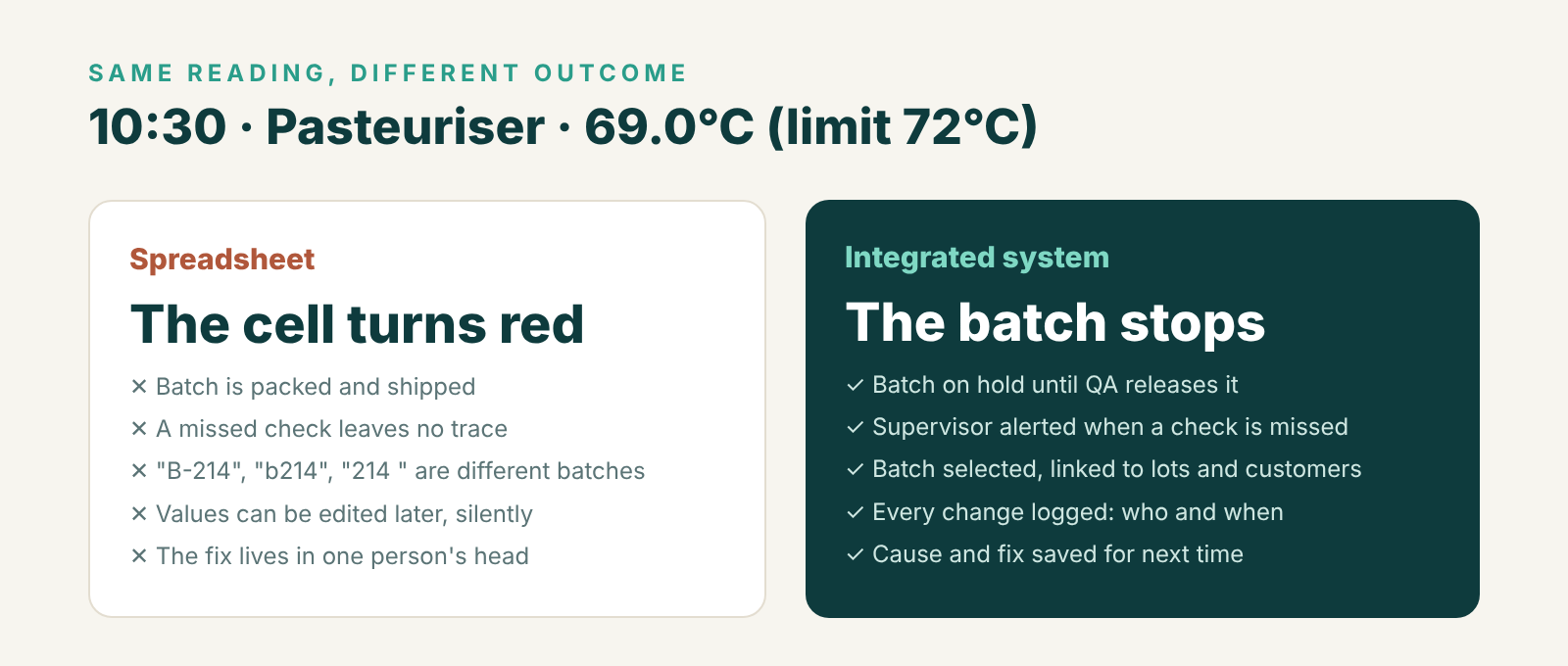
- The batch keeps moving. The cell turns red, but the product is packed, stored and shipped. A spreadsheet can't stop a truck.
- Missing checks are invisible. Excel shows only what someone typed. If the 10:30 check on Line 2 never happened, there is simply no row, and nobody notices until the weekly review or the audit.
- The batch number is free text. "B-214", "b214" and "214 " are three different batches to a spreadsheet, and none of them is linked to the raw-material lots that went in or the customers who received the product.
- Records can be changed without a trace. Values can be edited or deleted later, and nobody can tell who changed what, or when. Auditors know this, and they ask how your records are protected.
- Trends go unnoticed. A pasteuriser drifting from 74°C to 72.5°C over two weeks is hard to spot across dozens of sheets, until it finally crosses the limit.
The real loss: knowledge that walks out the door
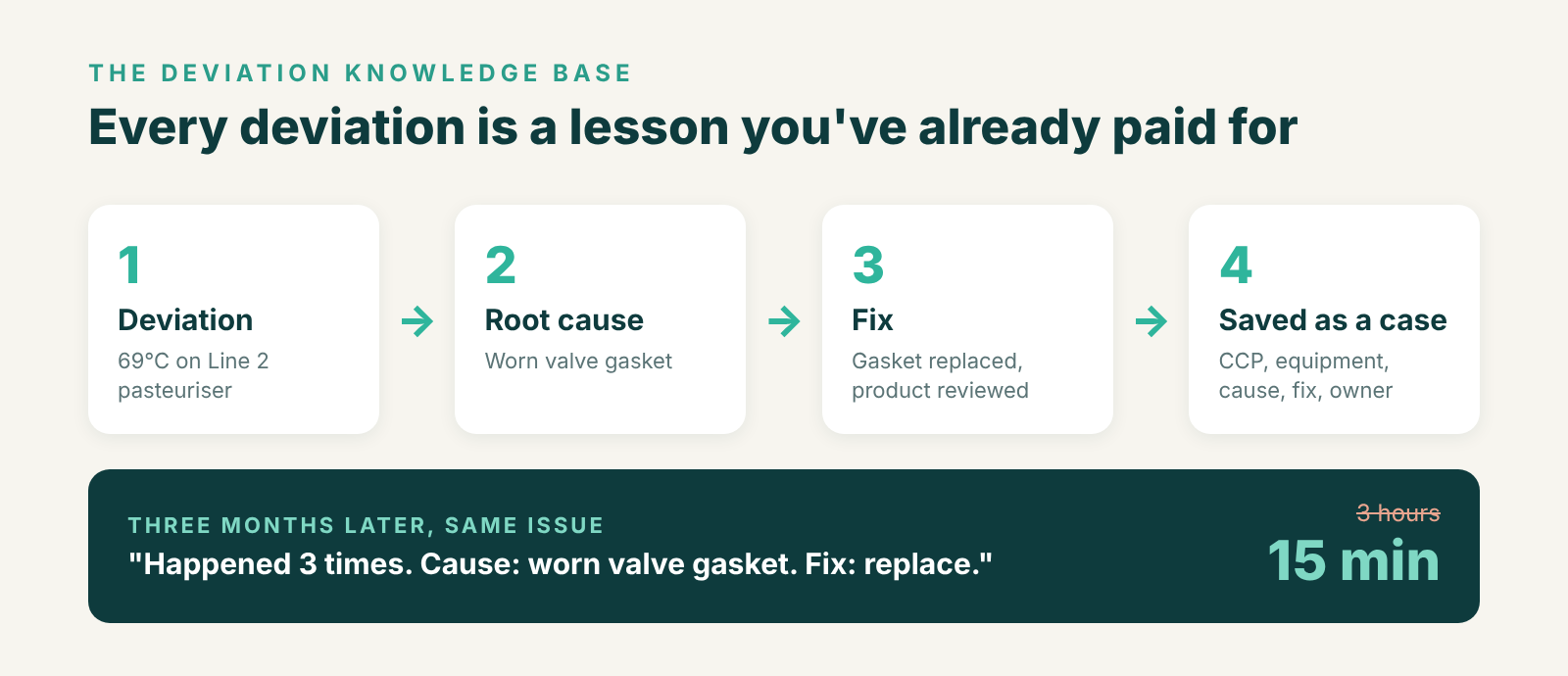
Now the most expensive part. A technician sees the deviation, finds the cause, say a worn valve gasket, and fixes it in fifteen minutes. Good work. But where does that knowledge go?
Usually into his head, or into a comment on row 4,812. Three months later the same parameter drops on the same line, during a night shift, and a different technician spends three hours finding the same gasket.
Every deviation is a lesson the plant has already paid for. Without a place to keep it, you pay for it again.
What changes with a system
An ERP with a food-safety layer doesn't make the reading faster to enter. It changes everything around it:
- An AI assistant for every technician. Every past deviation is stored with its CCP, equipment, root cause and fix, and an AI assistant can search all of it. A new technician on the night shift can ask, "Line 2 pasteuriser is at 69°C. What usually causes this?" Within minutes they get the likely causes based on past cases, the fix that worked, and who solved it last time. The plant's experience no longer depends on who happens to be on shift.
- Automatic hold. An out-of-limit value puts the affected batch on hold. It can't be shipped or invoiced until QA reviews and releases it.
- Alerts for missed checks. The system knows which checks are due, on which line, at what time, and alerts the supervisor when one is missed.
- Readings tied to real batches. The operator selects the batch from active production orders instead of typing it, so every reading is linked to the ingredients that went in and the customers who received it.
- Protected records. Every change is logged with who made it and when, which is exactly what IFS and BRCGS auditors expect to see.
- Trends and calibration in one place. Supervisors see drift before a limit is breached, and readings from an instrument with expired calibration are flagged.
Where equipment has a data logger or sensor, readings can also flow in automatically, which removes manual entry altogether. That depends on the line, but it's worth asking about.
The bottom line
Recording a CCP value is easy. Excel can do it. The value of monitoring lies in what happens next: the batch is held, the cause is found and recorded, and next time the fix takes fifteen minutes, not three hours.