HACCP Is Not a Binder on a Shelf: What Food Producers Need to Get Right
Food Safety Series · Part 1
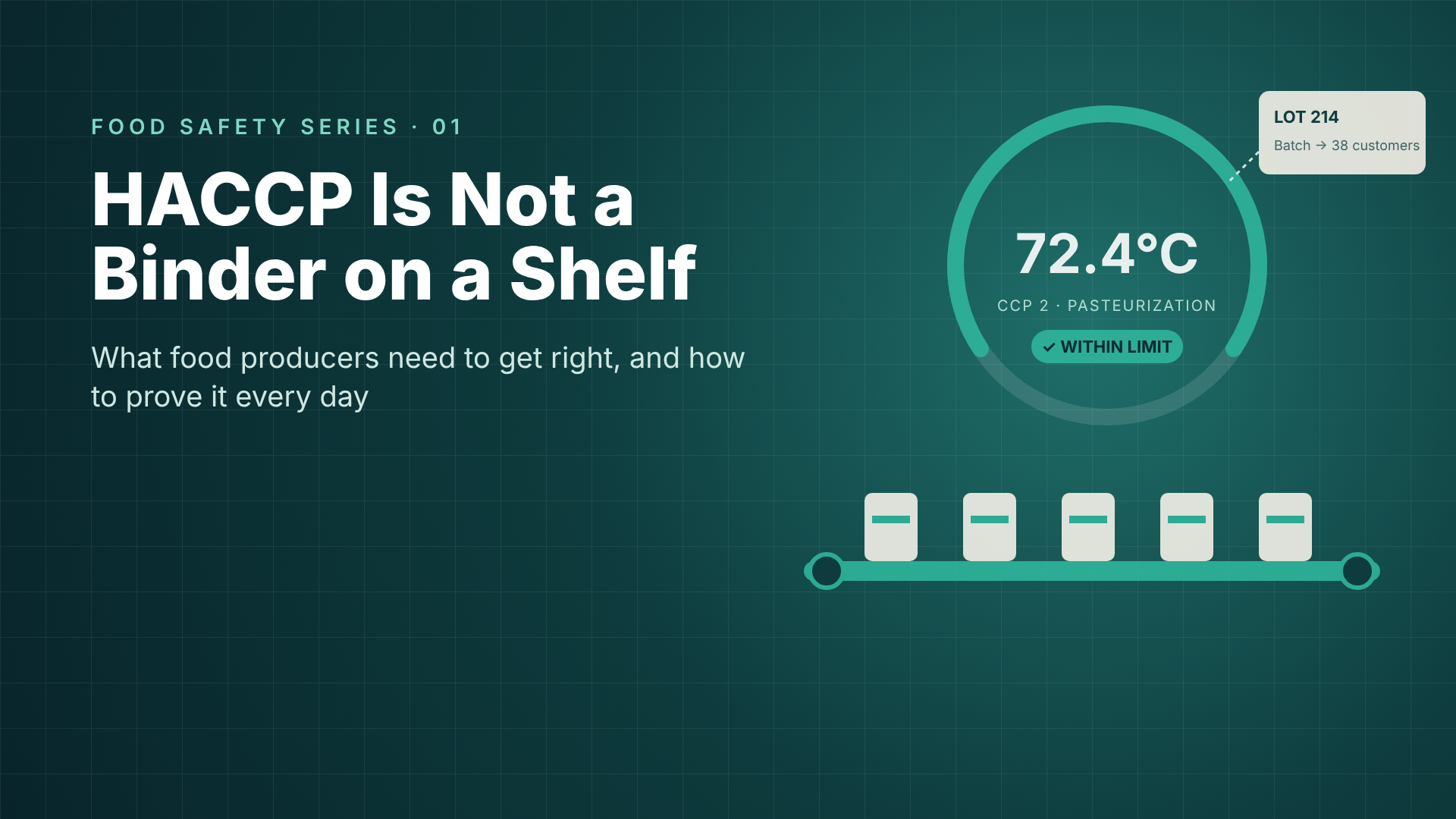
Walk into almost any small or mid-sized food plant and ask to see the HACCP plan, and someone will bring you a binder. It's usually thick and neatly printed. Often it was prepared by a consultant two or three years ago.
Then ask a different question: "Show me last Monday's pasteurization temperatures for batch 214, and tell me which customers received that batch."
That second question is what an inspector, an export buyer or an auditor will really ask. For many producers it takes hours to answer, if they can answer it at all.
With this article we're starting a series on food safety, HACCP, and how modern systems help producers move from "we have a plan" to "we can prove it every day."
HACCP: what it is not, and what it actually is
In many plants, HACCP is treated as one of these:
- A document you prepare once. A consultant writes the plan, it gets approved, and it goes on the shelf, while recipes, suppliers and equipment keep changing.
- The quality manager's job. Only one or two people know the CCPs. Operators fill in forms without knowing why a limit matters.
- Something to show the inspector. Records exist because someone will check them, not because anyone uses them to make decisions.
- Testing the finished product. If the lab result is fine, the batch is fine. But you can't test safety into a batch after it's made.
HACCP (Hazard Analysis and Critical Control Points) is something else entirely. It's a preventive system: you identify where things can go wrong in your process and control those points every shift, on every batch, before a hazard reaches the customer. It rests on seven principles:
- Analyse hazards: biological, chemical and physical risks at every step, from raw material to dispatch.
- Identify Critical Control Points (CCPs): the steps where control is essential, such as pasteurization, cooking, metal detection or chilling.
- Set critical limits: for example, the minimum time and temperature, or the maximum metal fragment size.
- Monitor: who checks, how often, and with what instrument.
- Define corrective actions: what happens to product when a limit is missed.
- Verify: confirm the system works through calibration, internal audits and lab tests.
- Keep records: evidence that all of the above actually happened.
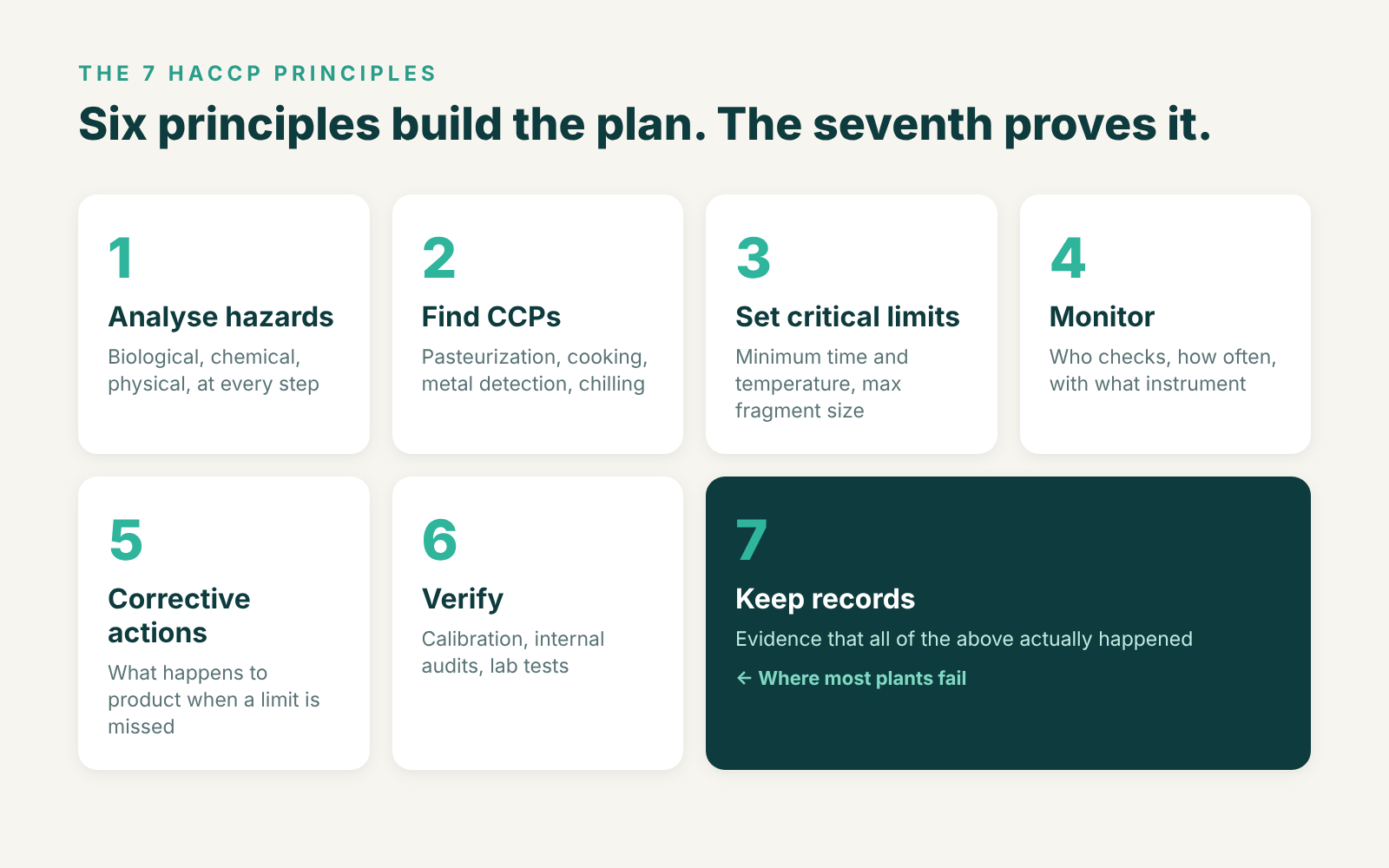
The first six principles describe a good plan. The seventh is where most plants struggle. If it isn't recorded, it didn't happen, at least not in an auditor's eyes.
Why this matters more than ever
Regulation. Food safety law in most markets requires producers to run HACCP-based procedures, and inspections are becoming more systematic. Food safety is no longer a "paper" requirement.
Export ambition. More and more producers of wine and spirits, cheese, fish, dried fruit, fresh produce and preserves are looking for buyers beyond their home markets. EU retailers and importers rarely stop at "HACCP-compliant." They ask for IFS Food, BRCGS or FSSC 22000 certification, and every one of those standards assumes a HACCP system that works, backed by traceability and corrective-action records.
Reputation travels fast. In a local market where everyone knows everyone, one incident can travel faster than any marketing campaign: a contaminated batch, a foreign-body complaint, a recall on social media. Large international brands can absorb a recall. A small or mid-sized producer often can't.
Customers are changing too. Supermarket chains, HoReCa groups and export distributors increasingly audit their suppliers. Food safety is becoming a commercial requirement, not only a legal one.
The real problem: paper doesn't scale
Most HACCP failures we see are not failures of knowledge. Quality managers usually know their CCPs very well. The failures are failures of execution and evidence:
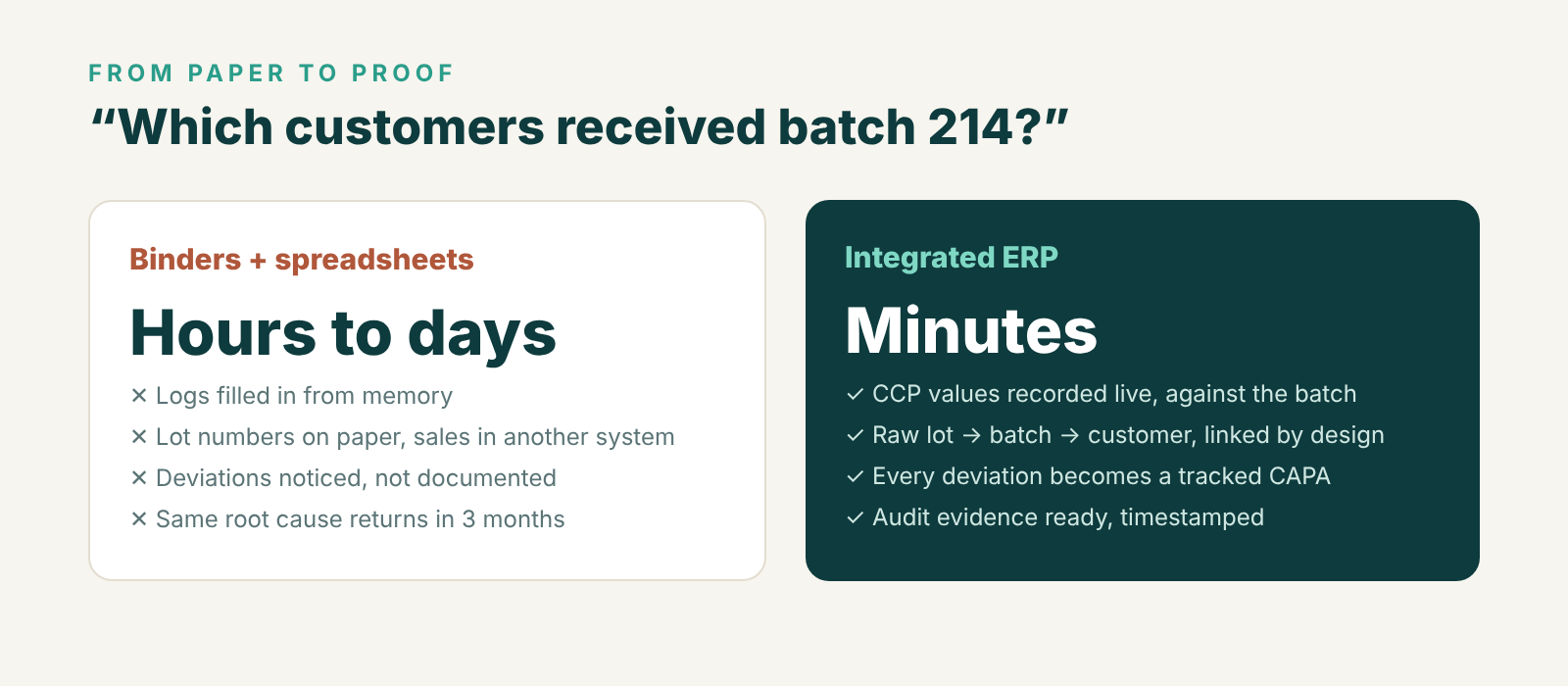
- Temperature logs filled in at the end of the shift, from memory.
- A deviation is noticed, but nobody records what happened to the affected product.
- Raw material lot numbers are written on paper, while production runs in Excel and sales in accounting software, with nothing linking them.
- A batch recall can take a whole day of digging through invoices.
- Corrective actions get closed, but the same root cause comes back three months later.
When food safety lives in binders and spreadsheets, it depends entirely on individual discipline. It also falls apart when the one person who "knows the system" goes on holiday.
Where an ERP system changes the picture
This is where food safety and business systems meet. A modern ERP doesn't replace your HACCP team. It gives them a backbone:
- CCP monitoring at the point of work. Operators record values on a tablet, against the actual batch, with automatic alerts when a limit is breached.
- Lot traceability by design. Every raw material lot is linked to the batches it went into, and every batch to the customers who received it. Forward and backward traceability takes minutes, not days.
- Corrective actions that actually close. Each deviation becomes a case with a root cause, an owner, a deadline and an effectiveness check. Repeat problems become visible.
- Audit-ready evidence. When the inspector or the IFS auditor arrives, the records are already there, complete and timestamped.
There's another benefit. The same data that proves food safety also shows your real cost per batch, your scrap rates and your supplier performance. Food safety stops being purely a cost centre.
What's next in this series
In the coming articles we'll go deeper: building CCP monitoring that operators actually use, traceability and mock recalls, CAPA, what IFS auditors really look for, and how producers can prepare for export audits step by step.